NYEC Weekly Member Policy Update June 12, 2026
News at NYEC
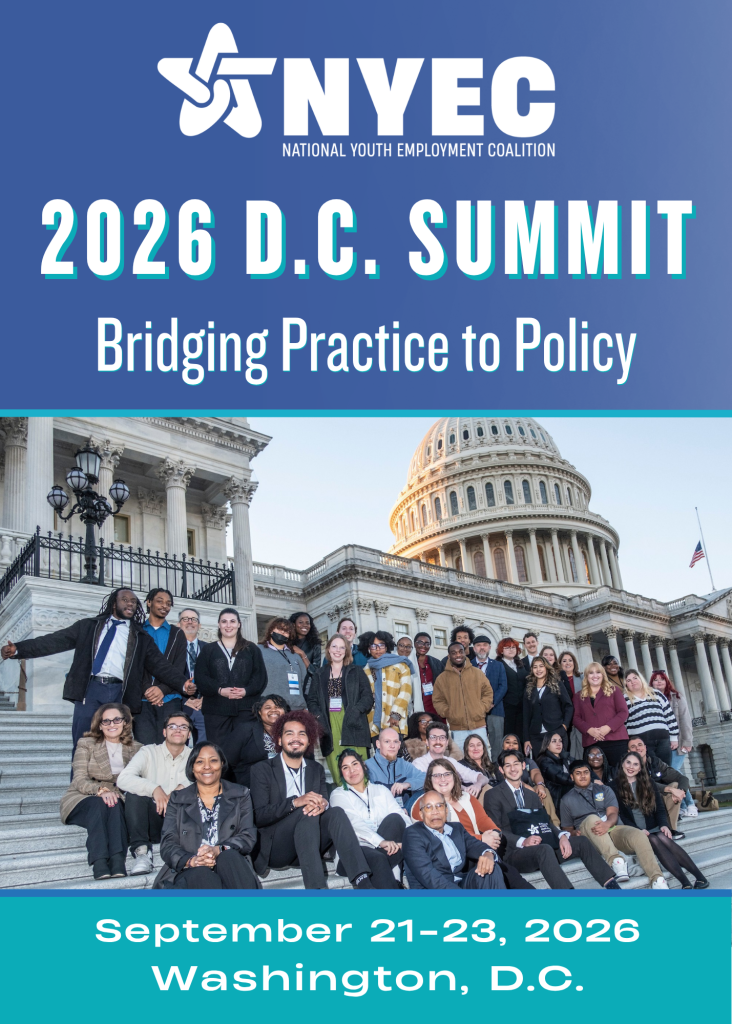
Registration is Open: NYEC’s DC Summit in Washington, DC – September 21–23! Formerly known as Youth Days, this is our convening that brings together practitioners, youth leaders, and partners to demonstrate the importance of investing in young people and the programs that support them. Early Bird registration ends July 15!
Legislative Branch
House Appropriations Committee Advances LHHS Bill, Proposes Large Cuts to Youth Workforce Development Programs: The bill, which provides funding for all youth workforce development programs, was advanced along party lines. The bill proposes concerning funding levels for NYEC priorities:
The Good:
- Apprenticeship: $290,000,000 (+$5m from FY26)
- YouthBuild: $107,500,000 (+$2.5m from FY26)
The Bad:
Job Corps: $880,078,000 (-$880m from FY26)
The Really Bad:
- Proposes to zero out WIOA Youth, Adult Education (WIOA Title II), and Reentry Employment Opportunities funding
These funding levels do not meet the need of youth-serving programs to support young people seeking employment opportunities. NYEC is encouraging its network to contact their Representatives to express why this bill would do more harm than good. A template can be found here.
Bipartisan Senators Introduce Bill to Track AI’s Impact on the Workforce: Senators Mark Kelly (D-AZ), Todd Young (R-IN), and Jim Banks (R-IN) introduced the Artificial Intelligence Data Authorization and Transparency Act (AI DATA), which would authorize and modernize federal labor market data surveys and reports, so workers, businesses, educators, researchers, and policymakers can better understand how artificial intelligence (AI) is reshaping and impacting the American workforce.
Executive Branch
- First Lady Melania Trump Launches Fostering the Future Accounts: First Lady Trump launched Fostering the Future Accounts, which would give foster youth asset ownership, long‑term wealth‑building, and financial independence when they turn 18. The program functions through federal agencies, including Treasury, HHS, and OMB, issuing guidance enabling state child welfare agencies to open accounts on behalf of foster youth to create dedicated savings and investment accounts for youth in foster care.
- Department of Education Announces Connecting Talent to Opportunity Semifinalists: The U.S. Department of Education announced the 10 states selected as semifinalists for the Connecting Talent to Opportunity (CTO) Challenge, a national call to action designed to strengthen the connections between learners and earners by accelerating the development of integrated, state-wide Talent Marketplaces.
From the States
- Virginia: Google announced a multibillion-dollar investment in the state of Virgina’s workforce aimed to train electricians and other skilled technical jobs in the area.
- Colorado: The Colorado Workforce Development Council (CWDC) and Office of Economic Development and International Trade (OEDIT) are hosting a webinar to explain next steps of their workforce development plan and bring more employers into the process to shape training pathways and provide work‑based learning opportunities.
- Michigan: House Bill (HB) 5727 seeks to roll back a state system set to be implemented this year by the Department of Labor and Economic Opportunity that will ensure employers know the law, protect children from exploitative work and aid in enforcement when violations of the state’s Youth Employment Standards Act occur.
Resources
- Child Trends Workforce Pell Blog: Workforce Pell offers a new funding stream for short‑term Early Care and Education (ECE) credentials, but the field faces barriers due to wage requirements and data reporting rules. This report highlights Child Trends’ recommendations for states.
- New America Blog: Vermont was the first state to codify child care as an entitlement in law, but it may not be the last. The blueprint now exists—it’s up to the changemakers to make it happen.
- AECF Kids Count Data Book 2026: The KIDS COUNT® indicators capture what children and youth need most across Economic Well-Being, Education, Health and Family and Community.
Federal Funding Opportunities
- ED Grant: Expanding Career Pathways and Workforce Readiness of Special Education Teachers and Early Intervention Personnel Through Registered Apprenticeships: The purpose of the Expanding Career Pathways and Workforce Readiness of Special Education Teachers and Early Intervention Personnel Through Registered Apprenticeships competition is to fund cooperative agreements that support registered apprenticeship programs that attract, prepare, and retain special education teachers or early intervention personnel. Applications are due July 13, 2026.
- HHS Grant: Foster Parents Network Analytics Hub (HUB): To support the Administration for Children and Families’ initiative, A Home for Every Child, the Children’s Bureau will award one grant to establish the Foster Parents Network Analytics Hub (HUB) to achieve a foster home-to-child ratio of more than 1:1 in every state by 2029. The HUB will advance the goal by providing states with advanced analytics tools and intensive technical assistance to optimize their foster parent networks. Applications are due July 14, 2026.
- HHS Grant: Community Economic Development Projects: The Office of Community Services (OCS) will award approximately $18.57 million in Community Economic Development (CED) discretionary funds to Community Development Corporations (CDC) to enhance job creation and business development for individuals with low income. Applications are due July 17, 2026.
- Forecasted HHS Grant: The Primary Prevention Youth Homelessness Demonstration Program: This funding opportunity provides funding to identify and implement strategies and services for youth and young adults between ages 12 and 26 in order to prevent homelessness, including strategies designed to serve youth and young adult populations with a high likelihood of experiencing homelessness, housing instability, particularly among youth at risk of human trafficking; struggling with substance abuse or mental health concerns; or transitioning out of foster care, the juvenile justice system, or a residential behavioral health system. Applications are due July 22, 2026.
- Workforce Opportunity for Rural Communities (WORC) Round 7: A Grant Initiative for the Appalachian, Delta, and Northern Border Regions: Provides $2 million to qualifying organizations including school boards, nonprofits, etc. Within the WORC region of the United States. Funds are coming from the Employment and Training Administration. Applications are due July 23, 2026.
- HUD Grant: Youth Homelessness Grant for FY2024 and FY2025: This grant opportunity will provide two separate sources of funding under two different program; YHSI grants (CFDA number 14.277) and YHDP (CFDA number 14.276). Both sets of funds were appropriated by Congress “to demonstrate how a comprehensive approach to serving homeless youth, age 24 and under … can dramatically reduce youth homelessness.” Applications are due July 29, 2026.
- HHS Grant: FY2026 Runaway Homeless Youth Training, Technical Assistance, and Capacity Building Center (RHYTTAC): The Runaway and Homeless Youth Training, Technical Assistance, and Capacity Building Center (RHYTTAC) provides direct training and technical assistance to existing RHY award recipients and subrecipients to enhance their efforts to successfully implement FYSB-funded projects. Applications are due August 3, 2026.
- Forecasted HHS Grant: FY 2026 Basic Center Program: The Basic Center Program (BCP) provides temporary, emergency shelter; and counseling services to youth who have left home without permission of their parents or guardians, have been forced to leave home, or other homeless youth who might otherwise end up in the law enforcement or in the child welfare, mental health, or juvenile justice systems. Applications are due August 3, 2026.
- HUD Grant: FY 2026 Continuum of Care Competition and Youth Homelessness Demonstration Program Grants: The Continuum of Care (CoC) Program is designed to promote a community-wide commitment to the goal of ending homelessness and provide funding for efforts by providers. Applications are due August 26, 2026.
NYEC Member Spotlight
- FHI 360’s National Institute for Work & Learning has gone global! Their new name is officially “Institute for Work and Learning” to reflect this exciting change.
- Attend JFF’s American Job Quality Study: Key Findings and Application for Educators Webinar June 25 to explore the five dimensions of job quality and the key findings of the study that push us to consider the intersection of pathways design and job quality.
National Youth Employment Coalition Questions? Contact nathan.hora@nyec.org