POLICY UPDATE 6-26-26
News at NYEC
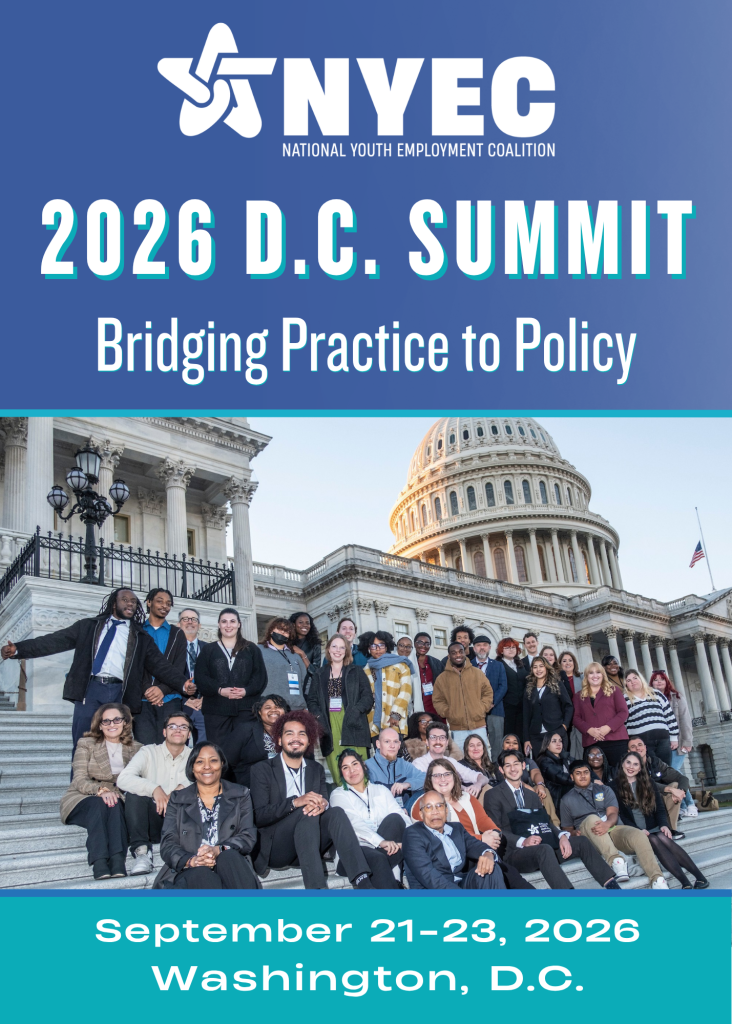
Registration is Open: NYEC’s DC Summit in Washington, DC – September 21–23! Formerly known as Youth Days, this is our convening that brings together practitioners, youth leaders, and partners to demonstrate the importance of investing in young people and the programs that support them. Early Bird registration ends July 15!
Legislative Branch
- Chairman Walburg Introduces AWARE Act: House Education and Workforce Committee Chairman Tim Walberg (R-MI) introduced H.R.9381, the AI Workforce Assessment and Research Enhancement or AWARE act. The bill would require the Bureau of Labor Statistics to compile statistics on the usage of AI in the workforce in order to respond to technological change more effectively and better inform workforce and education policy.
- Representatives Introduce Bill to Further Study of AI in the Workforce: Representatives Valerie P. Foushee (D-NC) and Greg Casar (D-TX) co-sponsored H.R.9427, which directs to Comptroller General of the United States to conduct a study on the impacts of artificial intelligence on the workforce in the United States.
- Senators Reintroduce the Summer for All Act: Senators Murphy (D-Conn) and Senator Andy Kim (D-NJ) members of the Senate Health, Education, Labor, and Pensions (HELP) Committee reintroduced the Summer for All Act. The bill would expand access to high-quality summer enrichment opportunities by creating two new federal grant programs. The bill would provide the long-term funding necessary for community-based organizations to offer free summer camps and activities to children currently unable to access them.
Executive Branch
No relevant Executive Branch updates.
From the States
- Mississippi: Mississippi reached a record high of 1,195,400 nonfarm jobs in May 2026, the highest employment level in the state’s history. State officials and workforce leaders credited strong economic development efforts, major business investments, and workforce training programs for the growth, while emphasizing opportunities in construction, advanced manufacturing, and other high-demand industries.
- California: California has launched the nation’s first public tool to monitor and track AI related job loss, fulfilling a key requirement of Governor Gavin Newsom’s executive order on AI and the workforce. The new California AI Unemployment Tracker, developed with the California Policy Lab (UCLA) and the Employment Development Department, provides monthly early warning indicators of potential AI‑driven job displacement. The dashboard is intended to help policymakers and the public understand where AI is affecting workers and where retraining, job search support, or other interventions may be needed.
Resources
- BlackRock Future Builders RFP: The BlackRock Foundation is offering $500,000–$1,000,000 grants (about 10–15 awards) to support high‑impact innovations that help close the skilled trades labor gap as part of its $100M Future Builders initiative. The grants run for two years and are open to organizations across the U.S. and Puerto Rico. Applications are due July 10, 2026, 11:59 PM.
- OpenAI Foundation: 2026 People-First AI Fund: The OpenAI Foundation is accepting applications for its 2026 People-First AI Fund, which has committed $50 million in unrestricted grants to support community-based nonprofits exploring how AI can strengthen their missions and communities. The fund prioritizes organizations working in three areas: community support services, community arts and cultural organizations, and community journalism and media. Eligible organizations must be US-based 501(c)(3)s with annual operating budgets between $500,000 and $10 million and must demonstrate deep community trust and genuine interest in learning about or experimenting with AI. Applications are due July 15.
- AI Workforce Technology Grant from Draper Richards Kaplan Foundatin and NextLadder Ventures: Draper Richards Kaplan Foundation in partnership with NextLadder Ventures launched its Navigation Technology Initiative, providing catalytic capital and hands-on support to early-stage organizations using technology and AI to help low-income Americans navigate economic opportunities and challenges. The initiative is focused on housing access, benefits of access, health access, workforce mobility, and financial stability. Awardees receive $300,000 in capital (equity investment or grant), up to $500,000 in in-kind support, and access to NLV’s network of co-investors and policy partners. Most awardees will be post-revenue with between $600K and $3M in annualized revenue or committed funding. Founder proximity to the population being served is a strong priority. They will invest in both for-profits, and 501(c)(3) s. Applications are reviewed on a rolling basis.
Federal Funding Opportunities
- ED Grant: Expanding Career Pathways and Workforce Readiness of Special Education Teachers and Early Intervention Personnel Through Registered Apprenticeships: The purpose of the Expanding Career Pathways and Workforce Readiness of Special Education Teachers and Early Intervention Personnel Through Registered Apprenticeships competition is to fund cooperative agreements that support registered apprenticeship programs that attract, prepare, and retain special education teachers or early intervention personnel. Applications are due July 13, 2026.
- HHS Grant: Foster Parents Network Analytics Hub (HUB): To support the Administration for Children and Families’ initiative, A Home for Every Child, the Children’s Bureau will award one grant to establish the Foster Parents Network Analytics Hub (HUB) to achieve a foster home-to-child ratio of more than 1:1 in every state by 2029. The HUB will advance the goal by providing states with advanced analytics tools and intensive technical assistance to optimize their foster parent networks. Applications are due July 14, 2026.
- HHS Grant: Community Economic Development Projects: The Office of Community Services (OCS) will award approximately $18.57 million in Community Economic Development (CED) discretionary funds to Community Development Corporations (CDC) to enhance job creation and business development for individuals with low income. Applications are due July 17, 2026.
- Forecasted HHS Grant: The Primary Prevention Youth Homelessness Demonstration Program: This funding opportunity provides funding to identify and implement strategies and services for youth and young adults between ages 12 and 26 in order to prevent homelessness, including strategies designed to serve youth and young adult populations with a high likelihood of experiencing homelessness, housing instability, particularly among youth at risk of human trafficking; struggling with substance abuse or mental health concerns; or transitioning out of foster care, the juvenile justice system, or a residential behavioral health system. Applications are due July 22, 2026
- Workforce Opportunity for Rural Communities (WORC) Round 7: A Grant Initiative for the Appalachian, Delta, and Northern Border Regions: Provides $2 million to qualifying organizations including school boards, nonprofits, etc. Within the WORC region of the United States. Funds are coming from the Employment and Training Administration. Applications are due July 23, 2026.
- HUD Grant: Youth Homelessness Grant for FY2024 and FY2025: This grant opportunity will provide two separate sources of funding under two different programs; YHSI grants (CFDA number 14.277) and YHDP (CFDA number 14.276). Both sets of funds were appropriated by Congress “to demonstrate how a comprehensive approach to serving homeless youth, age 24 and under … can dramatically reduce youth homelessness.” Applications are due July 29, 2026.
- HHS Grant: FY2026 Runaway Homeless Youth Training, Technical Assistance, and Capacity Building Center (RHYTTAC): The Runaway and Homeless Youth Training, Technical Assistance, and Capacity Building Center (RHYTTAC) provides direct training and technical assistance to existing RHY award recipients and subrecipients to enhance their efforts to successfully implement FYSB-funded projects. Applications are due August 3, 2026.
- Forecasted HHS Grant: FY 2026 Basic Center Program: The Basic Center Program (BCP) provides temporary, emergency shelter; and counseling services to youth who have left home without permission of their parents or guardians, have been forced to leave home, or other homeless youth who might otherwise end up in the law enforcement or in the child welfare, mental health, or juvenile justice systems. Applications are due August 3, 2026.
- HUD Grant: FY 2026 Continuum of Care Competition and Youth Homelessness Demonstration Program Grants: The Continuum of Care (CoC) Program is designed to promote a community-wide commitment to the goal of ending homelessness and providing funding for efforts by providers. Applications are due August 26, 2026.
NYEC Member Spotlight
- Kentuckiana Works, the backbone agency to “The Spot” in Louisville, Kentucky, shared the impact of their Young Adult Opportunity Center through firsthand account of a young person’s navigation to career success. They also highlighted the importance of federal investments in workforce dollars such as WIOA. Check it out here.
National Youth Employment Coalition Questions? Contact nathan.hora@nyec.org